
Tag: Certified Translation

  • High-Quality Medical Translation Backed by Certified Experts in Southeast Asia

    High-Quality Medical Translation Backed by Certified Experts in Southeast Asia

    Health trends across the ASEAN region show a significant rise in cross-border patient mobility. Many patients now choose to travel to neighbouring countries to obtain better, faster, or more affordable medical services. 

    This phenomenon, known as medical tourism, has driven a growing demand for reliable medical translation services. In this context, medical translation has become increasingly important to ensure accurate communication among patients, doctors, and healthcare institutions.

    The main challenge in ASEAN patient mobility is language and cultural differences. Mistranslation of medical terms or misinterpretation of cultural context can have serious implications for patient safety. 

    Therefore, medical translation must be carried out by professionals with a deep understanding of medical terminology, clinical procedures, and the cultural nuances of each country. For instance, medical translators must accurately convey medication dosages, procedure explanations, and descriptions of illnesses.

    Beyond communication, translation accuracy is also closely linked to legal compliance, particularly in medical documents, treatment consent forms, and patient records. Minor errors can pose legal risks for hospitals and medical personnel. 

    Hence, the strategic role of medical translation in supporting a safe, efficient, and reliable cross-border healthcare system in the ASEAN region cannot be overstated.

    The Stakes of Inaccurate Medical Translation

    Errors in medical translation can have serious consequences for patients and healthcare institutions. A common example is the mistranslation of medical prescriptions. 

    For example, the medical term ‘once daily’ incorrectly translated as ‘once every hour’ can lead to overdose and endanger the patient’s life. Another example is errors in translating informed consent, where patients do not fully understand the risks of medical procedures due to ambiguous or incomplete translations. 

    A concrete example is the case of Willie Ramirez. His family said he was intoxicado, meaning he was poisoned. However, the translator mistakenly translated it as ‘drunk,’ so the medical staff treated him for a drug overdose. Ramirez was actually experiencing a brain haemorrhage, and due to incorrect and delayed treatment, he suffered permanent paralysis.

    The impact is felt not only by patients but also by hospitals and healthcare professionals. Patients may experience severe side effects, lose trust in the healthcare system, and even take legal action. 

    For hospitals, translation errors can lead to lawsuits, reputational damage, and significant financial losses. Legally, inaccurately translated medical documents may also be deemed invalid, with implications for legal compliance and professional liability.

    Therefore, accuracy and linguistic competence are not just language matters but crucial to patient safety and institutional integrity. High-quality translation is the foundation of trust and safety in cross-linguistic medical communication.

    Certified Translation: Guaranteeing Accuracy and Trust

    Team of certified medical translators collaborating to provide accurate and reliable medical translations.

    Source: Freepik.com

    The role of certified medical translators is increasingly crucial in today’s multilingual healthcare sector. The demand for these professionals is on the rise, driven by the need for accurate and reliable cross-language medical communication. 

    A certified medical translator doesn’t just translate word-for-word. They also grasp the medical context, technical terminology, and legal implications of each translated document, making them an indispensable part of the healthcare system.

    Professional standards for medical translators are usually set by internationally or regionally recognised certification bodies, such as the IMIA (International Medical Interpreters Association), the ATA (American Translators Association), or national translator associations in ASEAN countries, such as the Malaysian Translators Association (MTA) or the Indonesian Translators Association (HPI). 

    Such certification ensures that translators possess linguistic expertise, medical competence, and a strong grasp of ethics and patient confidentiality. In addition, certification signifies the translator’s ability to handle essential documents, such as medical records, informed consent documents, clinical trial documents, and laboratory reports, with a high degree of precision and professionalism.

    Certified medical translation is not a simple word-for-word task. It’s a comprehensive process that requires an understanding of the clinical context, cultural adaptation, and the ability to ensure that medical meanings and instructions remain consistent across different healthcare systems. 

    Certified medical translators are not just translators; they are bridges that ensure patient safety, legal compliance, and the credibility of medical institutions. The quality of their translation is the primary foundation of safe and reliable cross-language healthcare services.

    Localization Considerations in Southeast Asia

    In the context of medical translation, Southeast Asia presents unique challenges due to the diversity of languages, cultures, and healthcare systems across countries. Indonesia, Malaysia, Thailand, Vietnam, and the Philippines have different medical terminology, communication styles, and legal standards. Localization, the process of adapting translations to the local context, is an essential step in ensuring that medical messages remain accurate and easily understood by healthcare professionals and patients alike.

    In Indonesia and Malaysia, many medical terms are derived from English but adapted differently.” The word stroke is translated as ‘stroke’ in Indonesia, but is often referred to as ‘angin ahmar’ in the Malay medical context. In Thailand, medical terms written in the Thai script require translators familiar with medical transliteration. 

    Meanwhile, in Vietnam, the medical terminology system is influenced by French, such as vitamin C, which is called vitamin Cô-sê. In the Philippines, the use of a mixture of English and Tagalog (Taglish) requires translators to adjust the tone and terminology to remain formal in a medical context.

    In addition to language, medical writing styles also differ. Medical reports in Indonesia tend to be descriptive, whereas in Thailand and the Philippines, they are more technical. Differences in local laws and medical standards are also significant, for example, the format of informed consent or drug labels, which are regulated by each country’s regulations.

    These challenges require translators to master not only language but also each country’s culture and healthcare system. A medical translator in ASEAN must be able to perform accurate localization to ensure cross-border medical communication remains safe, clear, and compliant with regulations.

    Introducing Our Certified Medical Translation Services in Southeast Asia

    SpeeQual Translation stands out as a trusted provider of medical translation services in Southeast Asia. Our deep understanding of how every word in a medical document can impact patient safety and clinical decisions sets us apart. We have designed our services to handle a wide range of medical documents, including medical devices, software, prescriptions, clinical trials, records, consent forms, and more.

    At SpeeQual Translation, our strength is our team of certified medical translators. Each member is highly experienced and possesses a deep understanding of medical terminology across various ASEAN languages, including Indonesian, Malaysian, Thai, Vietnamese, and Filipino. With their extensive regional experience, we can tailor translations to each country’s cultural context and local medical standards.

    At SpeeQual Translation, we not only ensure linguistic accuracy but also uphold the highest data security standards in accordance with international regulations. This includes those governing the protection of patient confidentiality. All our translation processes undergo multiple stages of review to guarantee precise, ethical, and legal results.

    With SpeeQual Translation, you get more than just a translation service. You get certified human expertise plus quality control, ensuring accurate, secure, and reliable medical translations across Southeast Asia. Our commitment to accuracy and reliability is designed to make you feel secure in your choice of translation service.

    Technology and Human Expertise in Medical Translation

    Certified medical translators’ role can never be replaced with advanced technology

    Source: Unsplash.com

    Machine translation is increasingly common in modern medicine for fast, efficient text translation. This technology speeds up translating large medical documents like research reports, clinical data, and publications. While fast, machine translation struggles with context, technical terms, and cultural nuances vital in medical communication. Relying solely on machine translation could potentially lead to misinterpretations and errors, underscoring the need for human oversight.

    On the other hand, human-certified translation remains the gold standard in medical document translation. A certified medical translator preserves meaning, clinical context, and legal accuracy—not just words. Even minor translation errors in prescriptions, diagnoses, or consent can endanger patients and create legal issues. In addition, certified translators are bound by a professional code of ethics that guarantees the confidentiality and integrity of patient data.

    The ideal solution combines translation technology with certified human oversight. Machines can handle large volumes quickly, while certified translators ensure that the final result remains accurate, legal, and ethical. This synergy results in efficiency without compromising safety and reliability in the translation of cross-language medical documents.

    Conclusion: Why Certified Medical Translation is a Must in Southeast Asia

    In Southeast Asia’s multilingual and multicultural healthcare landscape, your role is crucial. Certified medical translation is a necessity to ensure patient safety, legal compliance, and reliable medical communication. 

    Differences in language, terminology, and regulations between countries require your expertise and the support of trained and certified translators. 

    Only certified medical translators can ensure accurate, ethical, and standards-compliant translations. In today’s cross-border and digital healthcare era, certified medical translations are key to trust, professionalism, and safety in Southeast Asia.

    As a trusted provider of medical translation services, SpeeQual prioritises accuracy, confidentiality, and speed without compromising quality. Our certified medical translators know Southeast Asian languages and medical terms, bridging patients and healthcare providers. 

    Become relevant and trusted with the help of SpeeQual’s medical translation services! Contact our team for more information!
  • Certified Translation Services in Southeast Asia: Why They Matter More Than Ever

    Certified Translation Services in Southeast Asia: Why They Matter More Than Ever

    In the era of globalization, many aspects of life are increasingly cross-border. From education and business to medical treatment, everything can be done abroad. Southeast Asia is becoming a popular destination for many people to develop their businesses. Furthermore, the region’s education sector is rapidly growing, making it a popular destination for education. 

    In line with the region’s rapid economic development, medical treatments are becoming more sophisticated, and health awareness is growing.This is further supported by the region’s abundant natural resources, which continue to attract investment. 

    This is why people are looking to Southeast Asia as a promising new alternative in the fields of business, health, and education. However, this requires translated documents. 

    Certified translation services play a crucial role in preparing you for this exciting business expansion, empowering you to navigate the language barriers with ease. Why do you need certified translation? 

    Because translating essential documents requires careful attention to legal validity and authenticity, especially across the diverse and dynamic jurisdictions of Southeast Asia. 

    The role of certification in ensuring legal validity is crucial, providing you with the security and confidence that your documents will be recognized in other countries and make your activities seamless.

    What “Certified Translation Services” Actually Mean

    Certified translation services are translations officially validated by a certified translator or authorized agency. This validation process involves a thorough review of the translated document by the translator or agency, ensuring its accuracy and authenticity. 

    Once this review is complete, a certificate is issued, stating the document’s validity. This certification has legal standing, meaning your document is recognized by government agencies, courts, legal authorities, and even universities abroad.

    Certified translation is typically required for various important purposes, such as legal documents (contracts, agreements, birth and marriage certificates), academic documents (diplomas, transcripts), immigration documents (visas), business documents (company deeds, financial statements), and even medical documents. 

    For example, suppose you are collaborating with a partner from Singapore. To avoid misunderstandings between both parties, this service is essential. Furthermore, this translation effort helps prevent violations of applicable laws in that country. 

    Neglecting this crucial step could lead to severe consequences, including loss of trust from your partner, legal violations, and financial losses.

    So, who provides certified translations? Each country has a different name for those who provide certified translations. Generally, the term for those providing this certification is Official 

    Translator, which is a translator authorized by the government. In Indonesia, however, the term is Sworn Translator. Sworn translators are legally sworn and have the force of law, providing a strong legal backing that you can trust. 

    Unlike sworn translation, official translation does not require an oath. It is recognized by law, and the work does not always have to be done by a sworn translator.

    Why It’s Becoming So Important Today

    Currently, the need for certified translation services is increasing significantly, reflecting the global nature of the issue. Global mobility has increased significantly in recent years. More and more people are studying abroad, working across borders, relocating, and expanding their businesses internationally. 

    In this process, personal and professional documents such as diplomas, birth certificates, employment contracts, financial statements, and legal documents must be officially translated and legally recognized to be accepted by institutions in the destination country.

    Many international institutions, such as universities, immigration agencies, and government agencies, only accept documents that have been certified. Regular translations without certification are often considered invalid, risking rejection of visa applications, study enrollment, or other legal processes. 

    Therefore, having your documents translated by a certified or sworn translator is not just a formality, but a crucial step that guarantees the document’s validity and reliability, and avoids potential rejections and delays.

    Furthermore, digital transformation has accelerated cross-border movement. Global collaboration has increasingly enabled individuals and companies to interact across geographical boundaries. 

    However, this convenience also creates new risks, especially if the official documents exchanged lack legal force. Certified translation plays a crucial role in mitigating these risks, ensuring that even minor errors in language or legal terminology are caught. 

    This, in turn, prevents misinterpretation, delays, and legal issues in the destination country, thereby enhancing the efficiency and reliability of global digital activities. Therefore, certified translation is not just a formality. These services ensure every document has linguistic accuracy and legal validity.

    Certified Translation Services in Southeast Asia: A Growing Necessity

    With the rapid development of the Southeast Asian region and the increasing flow of globalization, certified translation services are increasingly needed. This is due to the increasing mobility of people, whether in education, business, health, or employment. 

    Countries like Indonesia, Malaysia, Vietnam, the Philippines, Singapore, and Thailand are among the most mobile in the region. Every year, thousands of students from these regions pursue their studies abroad. 

    Meanwhile, entrepreneurs and professionals collaborate across borders. Furthermore, digital technology has made this collaboration increasingly easy. To facilitate these activities, legally recognized official documents are an absolute requirement. 

    Such as diplomas, transcripts, letters of recommendation, birth certificates, employment contracts, and company documents,  all require translation by a certified translator to be accepted by universities, immigration agencies, or international business partners. 

    Unofficial translations, often rejected for lacking legal validity or accuracy, can lead to delays in processing applications, rejection of visa applications, or even legal issues in some cases.

    The role of certified translation in Southeast Asia is of paramount importance, as it serves as a bridge across the diverse legal and administrative systems of each country. This service ensures that every document is not only understood but also legally recognized in the destination country. 

    For instance, if you wish to work in Thailand but are originally from Vietnam, you must translate your visa and other supporting documents using this service. Without the stamp of a certified translator, your documents, no matter how complete, will not be accepted in the destination country.  

    What Documents Usually Need Certified Translation

    Not all documents require certified translation. However, several types of documents must be officially translated to be recognized by government agencies, universities, or legal authorities abroad. Here are some of the most common documents requiring certified translation.

    These documents include birth certificates, marriage certificates, death certificates, powers of attorney, and business contracts. 

    For example, when someone wants to marry a foreign national or register their marriage in another country, these documents must be translated by a certified translator to be legally valid.

    2. Academic Documents

    Academic documents, such as diplomas, transcripts, and training certificates, often require certified translation. Many universities abroad, such as in Australia, the UK, or Japan, only accept officially translated documents. 

    This way, prospective students can prove their qualifications without question. When applying to your dream university, you must have your academic documents translated by a certified translator.

    3. Business & Financial Documents

    Business and financial documents include financial reports, business permits, and international tender documents. Companies seeking expansion or participating in cross-border projects must ensure all their documents are legally recognized in the client country. 

    If a business fails to comply with applicable regulations, it will not be permitted to operate in the destination country.

    4. Immigration Files

    Certified translation for immigration is becoming increasingly important, as it becomes easier for people to migrate abroad. Why is this important? Without it, the residence permit application process can be delayed or even rejected. Some documents that require certified translation include visas, passport records, police clearances, and medical reports.

    The Benefits of Using Certified Translation Services

    Handling official documents across borders can be overwhelming, especially if they require translation. This is where certified translation services play a crucial role. Certified translation isn’t just about accuracy, it ensures your documents are officially recognized and safe to use worldwide. Here are some of the key benefits you should know.

    1. Credibility.

    Documents translated by certified translators are immediately recognized by official institutions, such as universities, embassies, or immigration offices. 

    You don’t need to worry about your documents being rejected simply because they’re deemed invalid; all documents are guaranteed authenticity.

    2. Accuracy

    Translations are performed by experienced professionals and adhere to high-quality standards. Therefore, the results are not only linguistically accurate but also appropriate in legal, academic, or technical contexts. There’s no risk of misinterpretation that could cause problems later.

    Certified documents usually come with an official stamp, translator’s signature, and certification statement, making them legally valid. This means you can use them immediately for legal purposes without the need for additional legalization. 

    Thus, you can work in other countries because your visa meets the legal requirements.

    4. Time efficiency

    Because the process complies with regulations, you don’t need to revise or complete the documents repeatedly. This saves you time and ensures everything is ready to use.

    5. Peace of mind

    With certified translation, all cross-border transactions become smoother and stress-free. You can rest assured knowing your documents are translated correctly, securely, and accepted anywhere in the world, providing you with a sense of security.

    How to Choose a Reliable Certified Translation Provider

    Choosing the right certified translation provider does require a bit of research, especially in Southeast Asia, where the need for cross-border document processing is increasing. Here are some tips for choosing a trusted and experienced service provider.

    1. Check the translator’s certification and legality

    Ensure they are a legally sworn or officially certified translator recognized by a government agency or professional body. This is crucial to ensure your translation has legal validity. 

    SpeeQual, for example, has a team of certified and legally recognized translators. This is what makes our translators trusted in translation certification.

    2. Review reputation and previous user reviews

    Trusted providers typically have positive testimonials from both individual and corporate clients. If many clients are satisfied with the accuracy and speed of their services, that’s a good sign. 

    Since its founding 27 years ago, SpeeQual has been trusted by clients from various sectors, from technology to automotive. SpeeQual also prioritizes quality and speed as part of its commitment to client satisfaction.

    3. Make sure the translator understands the context of your document

    Legal, academic, and business translations have different styles and terminology. An experienced provider like SpeeQual knows how to preserve the meaning and structure of a document’s original context, rather than simply translating it word for word.

    4. Choose a provider that offers multilingual services across Southeast Asia.

    Because the region is so diverse, a provider that can handle multiple languages ​​will be much more flexible and efficient. SpeeQual has a team of translators who can help you translate in more than 10 Southeast Asian languages.

    Conclusion: Certified Translation as the Bridge of Trust 

    Certified translation isn’t just about language—it’s about making global processes smoother and more secure. You’ll avoid misunderstandings that could lead to financial losses, intellectual property rights issues, and even legal disputes with your business partners. 

    This is a crucial aspect of international business that cannot be overlooked. Furthermore, with the translation of relevant documents, you can efficiently study and work abroad. Even medical documents require certified translation to ensure accuracy, legal validity, and confidentiality.

    Certified translation services are a bridge between you and your goals. Given this urgency, you need a trusted and experienced translation partner. More than a service, SpeeQual is a reliable support system in translating your important documents into other Southeast Asian languages. 

    We support you every step of the way as you navigate developments in this region, providing the guidance you need. So, don’t hesitate to consult us today about your translation needs! Let’s work together to make your international ventures a success!

  • What Is a Certified Translation? Understanding Certified Translation Services

    What Is a Certified Translation? Understanding Certified Translation Services

    Nowadays, certified translation services play a vital role in facilitating accurate communication. In today’s globalization world, the demand for translating official documents is steadily increasing. For example, a business cooperates with partners from other countries. To facilitate communication and prevent misunderstandings and legal issues, contracts and agreements should be translated to ensure clarity and accuracy. In fact, you can easily obtain a rough translation. However, will the translation be recognised as valid by government authorities and legal institutions? Therefore, the translation of official documents, such as legal, business, personal, and other professional documents, must be certified.

    A professional translator signing a certified translation document on a desk with a laptop and pen.

    This translation process is carried out meticulously and comprehensively without changing the meaning of the original language. Certified translations are more reliable because they provide official verification that the translated document is complete, accurate, and consistent with the original. This is what makes certified translation documents recognised by government authorities, courts, or other institutions that require them.

    As proof of official document translation, the translator or provider will sign the certification. This certification guarantees professional qualifications and responsibility for errors in the translation. This prevents you from incurring detrimental errors, such as legal problems or misunderstandings due to unofficial or inaccurate translations.

    What Is a Certified Translation?

    If you have thought that certified translation is merely a process of translating from one language to another, you are mistaken. Certified translation completed by a professional translator and officially verified (sometimes by a notary) depending on the country’s regulations.. In addition, certified translation is proof that the translator has translated the document accurately and completely in accordance with the original document.

    Certified translation will certainly make things easier for you. Imagine if a business wanted to expand to another country and was asked to provide documents translated into the local language. However, the company chose to simply translate the documents without obtaining certification for the translation. In the aftermath, the business might not have the permit to operate. Based on this analogy, certified translation is a must.

    A certified translation help prevent losses, misunderstandings, or potential legal violations. This is because this certification is proof that the translator or agency is responsible for any errors in their translation, such as unofficial or inaccurate translations.

    So, what should be included in a certification statement? A certified translation must include at least the following four pieces of information. First, the translator’s qualifications. Second, a statement that the translated document is complete and accurate. Next is the identification of the translated document and the language used. Lastly, the translator’s name and signature, as well as the date of translation.

    Why Certified Translations Are Important?

    Three different official documents (Marriage Certificate, University Diploma, Business Contract) with wax seals and official 'Certified Translation' stamps, highlighting the importance of official document accuracy.

    Certified translations are important because they ensure the credibility, accuracy and reliability of documents. This is especially true if the documents are used for international business, study, medical or legal purposes. With certified document translation, the relevant authorities or legal institutions will trust your documents. The proof of certified document translation is the credential in the form of an official stamp from a sworn translator or official translator. More than just a stamp, this credential shows that the translator has linguistic expertise. For example, a legal translator is someone who is an expert in the field of law, they understand legal terminology, culture nuances and legal jurisprudence. They also ensure that your documents are accepted without any problems, avoiding misunderstandings due to translation errors. In addition, credentials also ensure that the translated document does not change from its original meaning.

    In addition, certified translations make it easier for you to conduct business globally. This is because many countries accept certified document translations for various purposes. For instance, you may wish to continue your education abroad. Of course, you will need the assistance of a sworn translator or official translator to ensure that the translation is certified. Even if you translate very carefully, if there is no certified translation, your documents will be rejected. Hence, certified translations are invaluable. 

    Who Can Provide Certified Translation Services?

    So, where can you get a certified translation? You can obtain certified translation services from individual translators with professional certification, professional translator associations, awarding institutions, professional translation companies, or sworn translators. Professional translation companies usually have professional and experienced translators in their field. These companies can provide certified statements to confirm that the translation of the document is accurate and consistent with the original document.

    In addition to translation agencies, you can also work directly with independent professional translators. They are usually members of official professional organisations. Although independent, they also have special certification in the field of translation, making them capable of issuing certified translations.

    In addition, sworn translators can also issue such certifications. So, what is the difference between them and professional translators? Sworn translators are translators who are officially registered and authorised by government agencies. Because they are recognised by government agencies, sworn translators can provide sworn translations that are recognised by law. One country that has this nomenclature is Indonesia. With government recognition, sworn translators can issue certified translations.

    Alternatively, you may choose to obtain certified translations through an awarding institution. You can ask this institution for help in translating academic documents, such as diplomas or certificates related to academics that are certified by the institution.

    Types of Documents That Require Certified Translation

    Not all documents require certified translation. For example, you are a marketer at a cosmetics company and are going to promote your products at an overseas exhibition. You only need to translate your promotional materials directly.

    It’s different if you are born in Indonesia and want to apply for a family visa to the US. The US Embassy will ask for your birth certificate in English. However, your birth certificate is in Indonesian. Therefore, your birth certificate needs to be translated by a professional translator or a sworn translator and accompanied by a certified translation. This certification will ensure that your birth certificate is recognised by US immigration authorities. Only official documents require certified translations. Besides birth certificates, other personal documents that require certified translations are death certificates and marriage certificates. Both have legal force and are often used for administrative purposes, immigration within and outside the country, or legal matters.

    Business documents —such as contracts, financial reports, and company certificates— also often require certified translations. Contracts that have certified translations will have more validity. This is because there are fewer errors and they avoid legal disputes. In addition, financial reports also require this certification to avoid misunderstandings in the presentation of the reports. In addition, there are legal and academic documents that require this certification. Examples of legal documents are deeds, agreements, and powers of attorney. Meanwhile, academic documents include diplomas and transcripts.

    The Process of Getting a Certified Translation

    Now that you know what a certified translation is, let’s take a closer look at the certified translation process. A certified translation is obtained after an official document has been translated by a professional translator or sworn translator. If you work with a professional translator, you will receive a certification statement after the document has been translated. This certification contains a statement that the translation is complete and accurate, the translator’s identity, and the source and target languages. The translation and certificate are then printed on the letterhead of the translator or official translation agency. The same applies to the contents of a sworn translator’s certification statement. The difference is the presence of an official ‘sworn translator’ stamp.

    The process of obtaining a certified translation through a notary typically involves the following steps. After the translator has translated the document, they will submit it to a local notary. The notary will then check and verify the translator. In addition, the notary will check whether the translator fully understands the content of the translated document, without omitting, changing, or adding any information.  After the examination and verification process is complete, the notary will certify and declare that the document is true and accurate to the original document. In addition, in the certified translation, the notary declares that they have examined both documents directly. The notary may also provide an affidavit if required by the authorities.

    How to Choose the Right Certified Translation Service

    You can obtain certified document translations by choosing a trusted provider. This is important to ensure that your documents are accepted by official institutions. In addition, this ensures that the translations are accurate, professional, and legally valid. Here are some steps you need to take.

    1. Verify Accreditation and Credentials

    Make sure that the translation service agency has proof of certification, licensing, or membership.

    1. Check areas of expertise

    Choose an agency that has translators who are experts in their field.

    1. Review the certification process

    You should ask what type of certification you will receive. Will it be a translator’s declaration, a sworn translation, or a notarised translation?

    1. Consider the turnaround time and reliability

    Ask for a turnaround time estimate. Choose a professional service that is realistic without compromising on quality.

    1. Communication with clients

    Choose a provider who will listen to every need and provide the best advice for clients.

    By following these five steps, you can ensure quality and reliability. One provider that meets these standards is Speequal. Speequal prioritises speed without compromising high quality and provides solutions for you. For the past 27 years, Speequal has consistently delivered optimal service. With professional translators who are experts in their fields and fluent in various languages, Speequal has assisted clients from diverse backgrounds. From clients in the technology sector to the automotive industry. In the translation process, Speequal utilises CAT technology. This technology enables our translations to be more accurate.

    Certified vs. Notarized vs. Sworn Translation

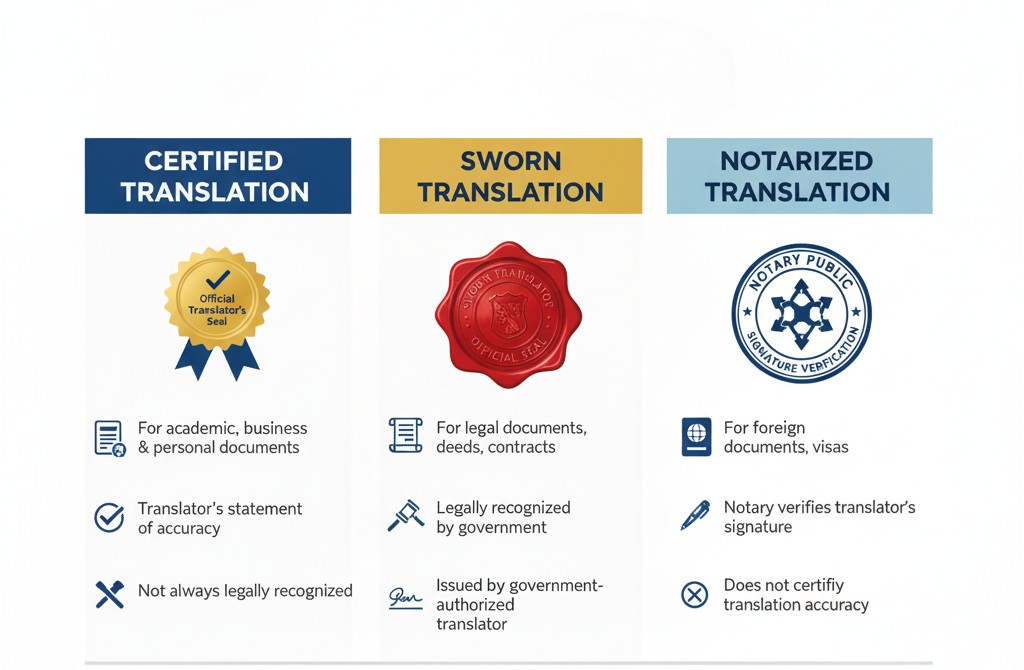
    Infographic comparing Certified Translation, Sworn Translation, and Notarized Translation, showing their different legal

    Many people are still confused about the difference between certified translations, notarised translations, and sworn translations. In fact, all three have different legal powers, purposes, and procedures. Certified translations include a statement of accuracy and completeness, while sworn translations are legally recognised because they are performed by a government-authorised translator. Meanwhile, notarised translations involve a notary verifying the translator’s signature. Meanwhile, a notarised translation only certifies the translator’s signature.

    Certified translation services will help protect your business through legal clarity in your contracts and agreements with your clients. To ensure the highest level of accuracy and legal validity, it’s crucial to work with a trusted translation agency. At Speequal, we have professional translators who will assist you in translating your official documents into the target language. In addition, we have a large pool of resources for all Asian languages. Accuracy and precision are the standards we apply to every translation process. This is what makes our clients satisfied with the quality of our services. Now it’s your turn to experience our best certified translation services. Contact us today!