
Category: Translation

  • A Complete Guide to Financial Document Translation for Global Companies

    A Complete Guide to Financial Document Translation for Global Companies

    In the era of rapid global business expansion, financial document translation has become essential for ensuring transparency, compliance, and trust among clients, investors, and stakeholders. Financial documents are a vital element of every company’s operations, containing critical information that must be understood accurately across languages and jurisdictions.

    The goal of financial document translation is to ensure clear communication, build trust, and support coordination between business units in international operations. Imagine if your investors withdrew from a project due to a lack of transparency in financial reports—perhaps because they misunderstood your data. Such situations highlight the importance of precise and professional financial document translation.

    However, financial translation differs significantly from other types of translation. It requires not only linguistic proficiency but also a deep understanding of economics, accounting, and global regulatory frameworks. Even minor translation errors can lead to major consequences—compliance issues, financial losses, or legal disputes. That is why companies must rely on translators who are experts in finance and experienced in handling sensitive business documents.

    What Are Financial Translation Services?

    What are financial translation services?

    Source: Freepik.com

    Financial translation services involve converting financial documents from one language to another while maintaining accuracy, consistency, and compliance with local laws. Translators must ensure that the meaning, tone, and intent remain faithful to the original text.

    Commonly translated financial documents include:

    • Financial statements
    • Contracts and agreements
    • Banking documents such as loan or account statements
    • Tax and compliance reports
    • Annual reports and investor relations materials

    These documents often reflect a company’s financial health, liquidity, and solvency—making accuracy non-negotiable.

    Key Aspects of Financial Document Translation

    1. Accuracy and precision

    Accuracy and precision are non-negotiable in financial document translation. Translators must be able to accurately convey complex financial concepts and data. This is because even the smallest error can turn profits into losses. Translation errors will prevent companies from making rational and timely investment decisions. In addition, accuracy will prevent misunderstandings that can lead to legal problems. 

    1. In-depth knowledge regarding financial

    Financial translators must understand accounting principles, financial terminology, and reporting standards to produce reliable translations.

    1. Compliance with regulations
      Translations must adhere to the financial and legal frameworks of the target country.
    2. Confidentiality

    Financial data is highly sensitive. Translators must implement strict confidentiality protocols to prevent leaks and misuse of information.

    1. Culture Relevance

    Translators must consider cultural and linguistic nuances to ensure that the translation is appropriate and professional in the target market.

    The Challenges in Financial Document Translation

    The challenges in financial document translation

    Source: Freepik.com

    Financial translation poses unique challenges that require a high level of skill and attention to detail.

    • DataSecurity Risk

    Data leaks can be disastrous for companies. Translators must use encrypted communication channels, comply with NDAs, and follow strict security standards to protect client data.          

    • Localization of Numerical and Linguistic Conventions

    Translators must adapt to each country’s conventions. For example, in the UK, thousands are separated by commas (£1,000.00), while in Germany, the notation is reversed (€1.000,00). Translators must also adapt to cultural communication styles—U.S. communication tends to be direct, while Japanese business culture values humility and subtlety.

    • Complex Financial Terminology

    Financial translation requires deep knowledge of both language and finance. Translators must understand financial concepts, accounting principles, and regulatory frameworks.

    • Constantly Changing Regulations

    Financial rules differ across countries and change frequently. Translators must stay updated on evolving international standards to ensure ongoing compliance.

    Key Qualities of a Professional Financial Translator 

    A financial translator must combine linguistic skill, financial expertise, and professionalism.

    1. Linguistic Mastery

    Fluency in both the source and target languages, along with an understanding of tone, style, and nuance, is essential.

    2. Financial Expertise

    Translators should have education or experience in accounting, finance, or economics to accurately interpret financial content.

    3. Confidentiality

    Professional translators follow strict confidentiality agreements (NDAs) to protect sensitive financial data.

    4. Professional Ethics

    Translators must act with integrity and maintain the highest ethical standards when handling sensitive business information.

    5. Localization Awareness

    Understanding local culture, financial systems, and conventions such as date formats and currency usage ensures translations feel natural and accurate.

    6. Time Management

    In the fast-moving business world, deadlines are critical. Translators must balance speed with precision.

    7. Collaboration and Communication

    Strong communication skills ensure clarity between translators, editors, and clients—preventing ambiguity and errors.

    The Process of Financial Document Translation 

    When translating a financial document, a translator needs to go through several stages.

    1. Initial Assessment

    The translator identifies the type of document (e.g., financial report, tax document, or banking record) and determines target languages and localization requirements.

    2. Terminology Management

    A glossary of key terms ensures consistency throughout the translation process—essential in financial language.

    3. Translation Stage

    Experienced financial translators, supported by Computer-Assisted Translation (CAT) tools, ensure accuracy, efficiency, and consistent terminology.

    4. Editing & Proofreading

    A second linguist reviews the translation for precision, readability, and alignment with the target audience’s expectations.

    5. Quality Assurance (QA)

    The QA process involves checking terminology, formatting, symbols, and numerical accuracy to eliminate errors.

    6. Data Security

    Strict security protocols protect all client documents from unauthorized access or misuse.

    Technology in Financial Translation 

    Technology plays an increasingly vital role in financial translation. CAT tools integrated with terminology management systems enhance consistency and reduce turnaround times.

    While AI can automate some aspects of translation, human expertise remains irreplaceable for understanding cultural nuances, context, and compliance. To balance both strengths, many professional agencies, including Speequal, use Machine Translation Post-Editing (MTPE). This method combines AI efficiency with human accuracy—producing translations that are precise, consistent, and tailored to client needs.

    Benefits of Using Professional Financial Translation Services 

    Even a single error in numbers, currency, or legal terminology can cause financial or reputational damage. Professional translators minimize these risks.

    1. Reduced Risk of Errors

    Even a single error in numbers, currency, or legal terminology can cause financial or reputational damage. Professional translators minimize these risks.

    2. Regulatory Compliance

    Experts familiar with IFRS and GAAP ensure that all documents meet local and international reporting standards.

    3. Enhanced Credibility

    Accurate financial translations strengthen trust, transparency, and long-term relationships with clients and investors.

    How to Choose the Right Financial Translation Partner 

    1. Identify Your Needs

    Define the document types, target languages, and quality requirements before choosing a partner.

    2. Evaluate Language and Financial Expertise

    Ensure the agency’s translators are fluent and have strong financial backgrounds. Review their samples or ask about terminology management methods.

    3. Check Industry Experience

    Select an agency with proven experience in financial translation and familiarity with global regulatory frameworks.

    4. Assess Quality Assurance Processes

    Confirm that they have rigorous QA and proofreading systems to maintain accuracy.

    5. Ensure Confidentiality

    Verify that translators work under strict NDAs and data protection protocols.

    6. Review Client Feedback

    Check case studies or testimonials to gauge credibility and past performance.

    The Future of Financial Translation 

    The future of financial translation lies in the synergy between human expertise and AI technology. While AI can streamline repetitive tasks and reduce costs, human translators remain essential for interpreting nuance, ensuring legal compliance, and managing risk.

    In the coming years, hybrid workflows that integrate AI and professional linguists will enable faster, more reliable, and cost-effective financial translations—supporting companies in their global expansion.

    Conclusion: Precision Is Profit 

    Accurate financial document translation is a long-term investment in your company’s credibility and success. Professionally translated financial documents build trust with clients and stakeholders, ensuring smoother international operations.

    At Speequal, our team of expert financial translators combines industry knowledge with cutting-edge CAT technology to deliver accurate, secure, and efficient translations. Our integrated terminology management ensures consistency across all documents—helping you communicate with clarity and confidence.

    Ready to ensure your financial documents meet global standards? Contact Speequal today.

    Are you ready to be assisted by our experienced translators? Contact us now!

  • Technical Translation Services: Ensuring Accuracy in Technical Document Translation

    Technical Translation Services: Ensuring Accuracy in Technical Document Translation

    Every product, from smartphones to industrial machines, comes with a guide — a technical document that bridges innovation and usability. But when your products reach global markets, one challenge arises: making sure every user, regardless of language, understands it clearly. That’s where technical translation services become indispensable.

    Although technical in nature, these documents are designed to be easily understood by users. They often serve as user manuals or guides that explain how to operate and maintain products safely and effectively. To reach international audiences, they must also be available in multiple languages — which makes technical translation a vital part of global communication.

    These translation services are not only for user manuals, but also for specifications, patents, scientific materials, regulatory and compliance documents, as well as technical drawings and plans. This translation not only translates documents from one language to another, but also requires in-depth knowledge of specific fields and the use of accurate terminology. This is to make it easier for readers who are not from specific fields. With this translation, you do not have to be an engineering graduate to understand how to use a new washing machine. 

    What Are Technical Translation Services?

    Technical translation services involve translating documents with specific contexts from one language to another. These services are commonly utilized in various fields, including medicine, engineering, and law. These translation services are important because the process requires a deep understanding of expertise in specific fields.

    Additionally, translating technical documents requires the use of terminology that is both appropriate and relevant to the industry in question. Meanwhile, this translation process ensures that documents such as user guides, patents, or scientific papers are clear, accurate, and comply with applicable regulations.

    Technical documents themselves vary greatly. Some examples are internal documents and end-user documents. Here is a more detailed explanation.

    End-User Documents

    These documents generally contain information to help users understand and use the product.

    1. User manual

    This document aims to explain how to use the product in a methodical and clear manner.

    1. Repair manual

    This book guides users through the process of troubleshooting problems that may arise with the product.

    1. Knowledge base

    This document contains a collection of questions and answers about problems that may occur, guidelines, and troubleshooting instructions.

    Internal Documents

    These documents are intended for employees or development teams to explain behind-the-scenes processes.

    1. Procedure manual

    This document contains steps for completing specific tasks or processes

    1. Technical Report

    This report contains findings or in-depth analyses used in a technical context

    1. API (Application Programming Interface) Documentation

    Aims to clearly and thoroughly explain how the API works and how to integrate it for other developers.

    The Challenges of Technical Document Translation

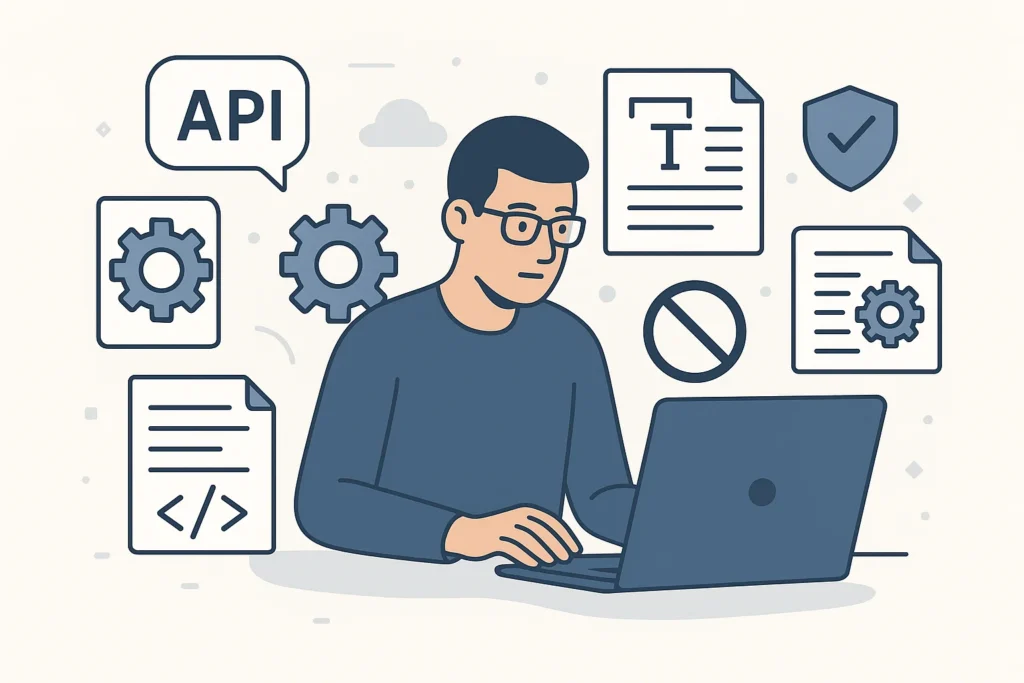
    Illustration of a technical translator working on complex documents surrounded by gears, text files, and symbols representing translation challenges

    Technical translation is more than just linguistic conversion — it’s about ensuring clarity, compliance, and precision. Yet, achieving this is far from easy.

    Technical translation requires precision, accuracy, and in-depth understanding. However, the translation process often presents challenges. Here are some of the challenges that are often encountered.

    1. Complex specialised terminology and jargon

    Technical documents often contain acronyms, industry-specific formulas, terms, and jargon. During this process, translators must be meticulous and have a deep understanding to avoid mistranslations. This is especially true when encountering jargon that has not been translated before.

    1. Complex terms

    Despite their complexity, translations must remain easy for users to understand.

    1. Accuracy and precision

    Neither companies nor users want to face losses. Some problems that may arise due to translation errors include equipment damage or user safety risks. Therefore, the translation of technical documents must be accurate and precise.

    1. New terminology

    As technical translators, they must keep up to date with new terminology. This is related to the daily developments in technology. These developments create new vocabulary for which there are not yet any translations. This is where the tricky part lies for translators: dealing with something that is very new and technical, but which must be conveyed in an accessible manner.

    1. Layout and technical format

    Translations must maintain the format and layout of the original document, which can sometimes be complex. These formats often contain code, images, or graphics.

    1. Differences in standards and language

    Technical documents need to be adapted to the language, laws, and cultural nuances of the local area. This is to ensure that they are understood by their users.

    The Role of a Professional Technical Translator

    Professional translator providing technical translation services for manuals and reports

    Source: Freepik

    A professional technical translator plays a role in translating technical documents accurately and scientifically. In general, professional technical translators will translate documents from one language to the target language. However, translators in this field not only need to be fluent in various languages but also have a deep understanding of the field being translated. For example, someone who translates technical documents is someone who is experienced in the field of engineering or is an engineering graduate. Additionally, a deep understanding and fluency in language will help companies expand into global markets. In addition, good translation will help communication to be clearer.

    Here are some of the responsibilities of a professional technical translator.

    • Field expertise

    Translators are experts and experienced in the field they translate, such as medicine, engineering, or IT.

    • Editing and quality assurance

    Editing your own translations as well as those of other translators is part of your responsibility for quality assurance.

    • Accurate translation

    Ensuring that technical documents such as patents, scientific reports, or user guides are translated accurately and clearly so that readers can understand the content of the document.

    • Collaboration

    Collaboration refers to communicating with developers or clients to verify the accuracy of the translation and resolve any ambiguities.

    • Terminology management

    Translators must choose terms that are appropriate for the document being translated.

    • Time management

    The translation process requires strict time management in order to be completed on time.

    The Process of Technical Document Translation

    To produce accurate, precise, and easy-to-understand translated documents, a lengthy process is required. Here is the process.

    1. Document Analysis

    The first stage is to analyse the document. The aim is to determine the type of document to be translated, the content of the document, the purpose, and the technical terms involved.

    1. Terminology Preparation

    Next, the translator will compile the technical terms from the source document and determine the appropriate equivalents in the target language. Translators can use technical glossaries or company terminology databases. However, if there are no equivalents, translators must create new terms.

    1. Translation Phase

    This is the core process. The translator will translate the document from the source language into the target language. Even when translating into a different language, the translator must maintain the technical meaning of the document. In addition, the translator must adapt the style of language to the target audience while remaining professional. The translator also uses terms that have been previously approved in the glossary.

    1. Editing & Proofreading

    After the translation process, the translated text is then edited by an editor who also has an understanding of the relevant field. The aim is to correct spelling, grammar, or terminology errors. In addition, this ensures that the translation does not change the original meaning.

    1. Formatting & Layout QA

    At this stage, the layout and format of the translation are verified. This is because technical documents often contain charts, tables, symbols, or diagrams, which require careful examination.

    1. Final Reviews

    Before being submitted to the client, the document is reviewed again by a senior translator to ensure there are no errors.

    Benefits of Using Professional Technical Translation Services

    Technical translation services will help you compete in the global business arena. This is because you are providing information about your products or services in a language that is easier for your clients to understand. This easy-to-understand delivery of information can be achieved by experienced professional technical translators. These translators apply a high degree of accuracy, have knowledge in their field, and are able to adapt to the culture of the target country.

    Here are some of the benefits of using professional services.

    1. Support compliance and risk management

    Accurate translation will help your company avoid the risk of legal violations that may arise from misunderstandings or misinterpretations due to language differences. In addition, this translation can strengthen the company’s reputation by demonstrating professionalism and clarity.

    1. Reach global markets

    Technical document translation is one strategy for getting closer to a global audience. Through technical translation documents, companies foster audience trust and experience by adapting to the applicable language, culture, and standards.

    1. Confidentiality is maintained

    Professional translators guarantee the confidentiality of sensitive company information by complying with standards and ethics.

    Choosing the Right Technical Translation Partner

    Selecting the right translation partner can determine the success of your global expansion. When evaluating potential partners, consider the following factors. The steps in choosing a partner are as follows.

    1. Experts in their field

    Select an agency or translator who is experienced and an expert in their field. This selection is important because it can affect the quality of your technical document translation. Choose an agency that has a team of translators with experience in the relevant field, so that the translation results are error-free. At Speequal, our translators have relevant experience and education, so their depth of understanding is unquestionable.

    1. Use of technology

    The use of technology will speed up and simplify the work. This is also the case with us at Speequal, where we utilise CAT as a technology in the translation process. Some examples include terminology management, file analysis, project setting, and reference material compilation. This technology will speed up the translation results without reducing the context.

    1. Quality assurance

    At Speequal, we have a strict quality control process. To ensure the quality of our translations, we use checking tools.

    1. Speed

    At Speequal, we prioritise fast communication with our clients. This is proof that we listen to each of our clients’ needs.

    Conclusion: Precision Builds Trust

    In technical translation, precision isn’t just a goal — it’s the foundation of trust. Technical document translation is a necessity for companies, especially those engaged in global business. Translating these documents is not merely a matter of providing information about products or services, but also serves as a means for companies to communicate with users or clients. This effort is one way for companies to build trust with users or clients.

    However, building trust requires precision. Therefore, the translation process must be carried out in collaboration with professional technical translators who are experts in their field. Professional translators have experience and education relevant to the field in question. Hence, they have a deep understanding of their field.

    At Speequal, we have a team of experienced professional technical translators. In addition to their experience, we have a technology-driven quality control process that minimises translation errors. Since our establishment 27 years ago, we have been trusted by a wide range of clients, from technology to automotive.

    Precision is our output, ensuring every result is of the highest quality. This is our effort to help you build trust between you and your clients. Are you ready for us to assist you in your journey to build trust? Contact us now!

  • What Is a Certified Translation? Understanding Certified Translation Services

    What Is a Certified Translation? Understanding Certified Translation Services

    Nowadays, certified translation services play a vital role in facilitating accurate communication. In today’s globalization world, the demand for translating official documents is steadily increasing. For example, a business cooperates with partners from other countries. To facilitate communication and prevent misunderstandings and legal issues, contracts and agreements should be translated to ensure clarity and accuracy. In fact, you can easily obtain a rough translation. However, will the translation be recognised as valid by government authorities and legal institutions? Therefore, the translation of official documents, such as legal, business, personal, and other professional documents, must be certified.

    A professional translator signing a certified translation document on a desk with a laptop and pen.

    This translation process is carried out meticulously and comprehensively without changing the meaning of the original language. Certified translations are more reliable because they provide official verification that the translated document is complete, accurate, and consistent with the original. This is what makes certified translation documents recognised by government authorities, courts, or other institutions that require them.

    As proof of official document translation, the translator or provider will sign the certification. This certification guarantees professional qualifications and responsibility for errors in the translation. This prevents you from incurring detrimental errors, such as legal problems or misunderstandings due to unofficial or inaccurate translations.

    What Is a Certified Translation?

    If you have thought that certified translation is merely a process of translating from one language to another, you are mistaken. Certified translation completed by a professional translator and officially verified (sometimes by a notary) depending on the country’s regulations.. In addition, certified translation is proof that the translator has translated the document accurately and completely in accordance with the original document.

    Certified translation will certainly make things easier for you. Imagine if a business wanted to expand to another country and was asked to provide documents translated into the local language. However, the company chose to simply translate the documents without obtaining certification for the translation. In the aftermath, the business might not have the permit to operate. Based on this analogy, certified translation is a must.

    A certified translation help prevent losses, misunderstandings, or potential legal violations. This is because this certification is proof that the translator or agency is responsible for any errors in their translation, such as unofficial or inaccurate translations.

    So, what should be included in a certification statement? A certified translation must include at least the following four pieces of information. First, the translator’s qualifications. Second, a statement that the translated document is complete and accurate. Next is the identification of the translated document and the language used. Lastly, the translator’s name and signature, as well as the date of translation.

    Why Certified Translations Are Important?

    Three different official documents (Marriage Certificate, University Diploma, Business Contract) with wax seals and official 'Certified Translation' stamps, highlighting the importance of official document accuracy.

    Certified translations are important because they ensure the credibility, accuracy and reliability of documents. This is especially true if the documents are used for international business, study, medical or legal purposes. With certified document translation, the relevant authorities or legal institutions will trust your documents. The proof of certified document translation is the credential in the form of an official stamp from a sworn translator or official translator. More than just a stamp, this credential shows that the translator has linguistic expertise. For example, a legal translator is someone who is an expert in the field of law, they understand legal terminology, culture nuances and legal jurisprudence. They also ensure that your documents are accepted without any problems, avoiding misunderstandings due to translation errors. In addition, credentials also ensure that the translated document does not change from its original meaning.

    In addition, certified translations make it easier for you to conduct business globally. This is because many countries accept certified document translations for various purposes. For instance, you may wish to continue your education abroad. Of course, you will need the assistance of a sworn translator or official translator to ensure that the translation is certified. Even if you translate very carefully, if there is no certified translation, your documents will be rejected. Hence, certified translations are invaluable. 

    Who Can Provide Certified Translation Services?

    So, where can you get a certified translation? You can obtain certified translation services from individual translators with professional certification, professional translator associations, awarding institutions, professional translation companies, or sworn translators. Professional translation companies usually have professional and experienced translators in their field. These companies can provide certified statements to confirm that the translation of the document is accurate and consistent with the original document.

    In addition to translation agencies, you can also work directly with independent professional translators. They are usually members of official professional organisations. Although independent, they also have special certification in the field of translation, making them capable of issuing certified translations.

    In addition, sworn translators can also issue such certifications. So, what is the difference between them and professional translators? Sworn translators are translators who are officially registered and authorised by government agencies. Because they are recognised by government agencies, sworn translators can provide sworn translations that are recognised by law. One country that has this nomenclature is Indonesia. With government recognition, sworn translators can issue certified translations.

    Alternatively, you may choose to obtain certified translations through an awarding institution. You can ask this institution for help in translating academic documents, such as diplomas or certificates related to academics that are certified by the institution.

    Types of Documents That Require Certified Translation

    Not all documents require certified translation. For example, you are a marketer at a cosmetics company and are going to promote your products at an overseas exhibition. You only need to translate your promotional materials directly.

    It’s different if you are born in Indonesia and want to apply for a family visa to the US. The US Embassy will ask for your birth certificate in English. However, your birth certificate is in Indonesian. Therefore, your birth certificate needs to be translated by a professional translator or a sworn translator and accompanied by a certified translation. This certification will ensure that your birth certificate is recognised by US immigration authorities. Only official documents require certified translations. Besides birth certificates, other personal documents that require certified translations are death certificates and marriage certificates. Both have legal force and are often used for administrative purposes, immigration within and outside the country, or legal matters.

    Business documents —such as contracts, financial reports, and company certificates— also often require certified translations. Contracts that have certified translations will have more validity. This is because there are fewer errors and they avoid legal disputes. In addition, financial reports also require this certification to avoid misunderstandings in the presentation of the reports. In addition, there are legal and academic documents that require this certification. Examples of legal documents are deeds, agreements, and powers of attorney. Meanwhile, academic documents include diplomas and transcripts.

    The Process of Getting a Certified Translation

    Now that you know what a certified translation is, let’s take a closer look at the certified translation process. A certified translation is obtained after an official document has been translated by a professional translator or sworn translator. If you work with a professional translator, you will receive a certification statement after the document has been translated. This certification contains a statement that the translation is complete and accurate, the translator’s identity, and the source and target languages. The translation and certificate are then printed on the letterhead of the translator or official translation agency. The same applies to the contents of a sworn translator’s certification statement. The difference is the presence of an official ‘sworn translator’ stamp.

    The process of obtaining a certified translation through a notary typically involves the following steps. After the translator has translated the document, they will submit it to a local notary. The notary will then check and verify the translator. In addition, the notary will check whether the translator fully understands the content of the translated document, without omitting, changing, or adding any information.  After the examination and verification process is complete, the notary will certify and declare that the document is true and accurate to the original document. In addition, in the certified translation, the notary declares that they have examined both documents directly. The notary may also provide an affidavit if required by the authorities.

    How to Choose the Right Certified Translation Service

    You can obtain certified document translations by choosing a trusted provider. This is important to ensure that your documents are accepted by official institutions. In addition, this ensures that the translations are accurate, professional, and legally valid. Here are some steps you need to take.

    1. Verify Accreditation and Credentials

    Make sure that the translation service agency has proof of certification, licensing, or membership.

    1. Check areas of expertise

    Choose an agency that has translators who are experts in their field.

    1. Review the certification process

    You should ask what type of certification you will receive. Will it be a translator’s declaration, a sworn translation, or a notarised translation?

    1. Consider the turnaround time and reliability

    Ask for a turnaround time estimate. Choose a professional service that is realistic without compromising on quality.

    1. Communication with clients

    Choose a provider who will listen to every need and provide the best advice for clients.

    By following these five steps, you can ensure quality and reliability. One provider that meets these standards is Speequal. Speequal prioritises speed without compromising high quality and provides solutions for you. For the past 27 years, Speequal has consistently delivered optimal service. With professional translators who are experts in their fields and fluent in various languages, Speequal has assisted clients from diverse backgrounds. From clients in the technology sector to the automotive industry. In the translation process, Speequal utilises CAT technology. This technology enables our translations to be more accurate.

    Certified vs. Notarized vs. Sworn Translation

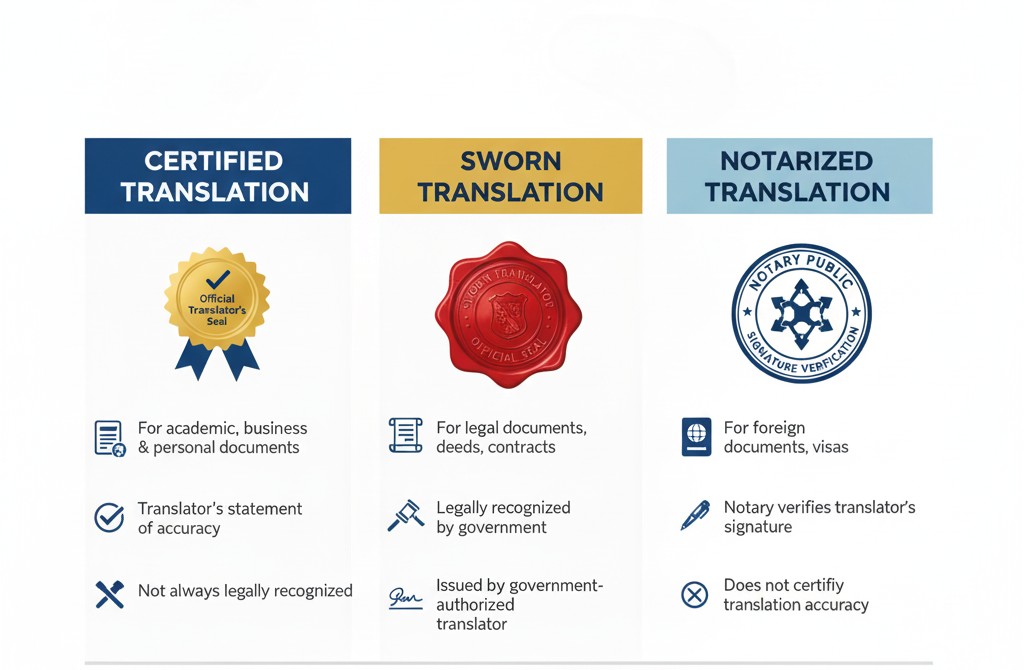
    Infographic comparing Certified Translation, Sworn Translation, and Notarized Translation, showing their different legal

    Many people are still confused about the difference between certified translations, notarised translations, and sworn translations. In fact, all three have different legal powers, purposes, and procedures. Certified translations include a statement of accuracy and completeness, while sworn translations are legally recognised because they are performed by a government-authorised translator. Meanwhile, notarised translations involve a notary verifying the translator’s signature. Meanwhile, a notarised translation only certifies the translator’s signature.

    Certified translation services will help protect your business through legal clarity in your contracts and agreements with your clients. To ensure the highest level of accuracy and legal validity, it’s crucial to work with a trusted translation agency. At Speequal, we have professional translators who will assist you in translating your official documents into the target language. In addition, we have a large pool of resources for all Asian languages. Accuracy and precision are the standards we apply to every translation process. This is what makes our clients satisfied with the quality of our services. Now it’s your turn to experience our best certified translation services. Contact us today!

  • Beyond Words: Why Legal Translation Services Are a Strategic Investment for Global Businesses

    Beyond Words: Why Legal Translation Services Are a Strategic Investment for Global Businesses

    Legal translation services are essential for businesses operating internationally. They help companies communicate effectively with clients who speak different languages and come from diverse cultures. If a multinational company ignores the culture, language, or laws of a partner country, it risks losing client trust. This can lead to reputational damage, financial losses, strained business relationships, or even legal and ethical violations that may result in fines or loss of intellectual property.

    For these reasons, legal translation should be a key component of any global business strategy. Moreover, legal translation acts as a gateway for companies to ensure compliance with applicable international laws.

    The cost of legal translation varies depending on several factors, including the complexity of the document, urgency, target language, and the type of translator—sworn or non-sworn. Sworn translators typically charge higher fees because they hold government-recognized certification and legal authority, making their translations valid for official and legal purposes.

    In Indonesia, the rate for sworn translators ranges from Rp 50,000 to Rp 500,000 per page, with complex documents such as contracts and court papers typically charged at the higher end. However, beyond pricing, it’s crucial to understand that accuracy and legal compliance hold far greater value than simply choosing the cheapest option.

    Visual comparison showing how accurate legal translation prevents contract disputes and legal risks.

    Source: Pixabay.com

    Legal translation plays a crucial yet often underestimated role in international business. Many companies overlook its importance, assuming it is merely a linguistic task. In reality, professional legal translators are experts in law. They understand legal terminology, systems, jurisdictional procedures, cultural nuances, and the linguistic context of both the source and target countries.

    Their work ensures clarity, compliance, and risk mitigation across global operations by producing legally accurate documents in the target language. In addition, legal translation helps prevent costly disputes caused by contract misinterpretations between business partners. Translating business contracts is not just an option but a necessity, as misunderstandings can lead to significant financial losses.

    With precise legal translation, companies can clearly define each party’s rights and obligations, fostering trust and stability in cross-border business relationships.

    One of the most overlooked risks in international business is translation error. A single mistranslated clause can lead to contract breaches, regulatory non-compliance, or even lawsuits. Legal translations performed by non-experts often contain such errors, as they lack understanding of legal systems and local laws.

    These inaccuracies can quickly become liabilities when they cause financial losses, disputes, or reputational harm. To avoid such consequences, accuracy in legal translation is non-negotiable. It ensures the validity of legal documents, protects rights and obligations, maintains confidentiality, and minimizes the risk of financial and legal repercussions.

    The true cost of legal translation services includes both direct and indirect expenses.

    • Direct costs depend on language pair, document complexity, urgency, and translator expertise.
    • Indirect costs include project management inefficiencies or losses due to poor-quality translations.

    For pricing methods, legal translation services may charge:

    1. Per word – Common for lengthy or ongoing documents.

    2. Per page – Used for certificates, diplomas, or short documents.

    3. Per hour – Applied for projects involving continuous revisions or desktop publishing.

    In Indonesia, sworn translators generally charge between Rp 50,000 and Rp 500,000 per page. The more complex or specialized the language (e.g., Mandarin, Japanese, or Arabic), the higher the cost compared to English or Bahasa Indonesia.

    Ultimately, the cost of legal translation should be viewed as an investment in precision and risk prevention, not just a transactional expense.

    Expert legal translators do more than translate words. They interpret meaning within a legal framework. They possess deep knowledge of both legal systems, strong research and linguistic skills, and high precision to ensure the legal intent remains intact.

    Certified translators are authorized to produce legally recognized translations for documents such as contracts, court rulings, and birth certificates. They also attach a statement of accuracy to guarantee reliability. To become certified, translators must undergo formal training, pass specialized examinations, and gain recognition from legal or governmental institutions.

    Working with certified experts minimizes legal risk and ensures documents meet international legal standards, because even minor translation errors can have major consequences.

    When choosing a legal translation provider, prioritize those that implement rigorous quality assurance processes and employ certified legal translators proficient in both the target language and legal system.

    Check whether the provider’s translators are members of recognized professional associations and whether they use technology such as translation memory (TM) or CAT tools to maintain accuracy and efficiency.

    Also, evaluate the provider’s experience and reputation by reviewing client testimonials and case studies.

    For example, Speequal has been trusted by clients in various industries, including technology and automotive. The company emphasizes speed, quality, and tailored solutions, supported by a multilingual in-house team and AI-assisted tools that improve translation consistency and workflow efficiency.

    Although legal translation may seem costly upfront, it offers measurable returns. Professional translation ensures compliance, opens access to new markets, protects company reputation, and minimizes legal risks -all of which contribute to long-term profitability.

    ROI can be calculated by comparing total translation costs and technology investments against financial benefits gained through reduced risks and expanded opportunities. Many companies realize the true return on investment once they avoid potential legal disputes or international fines.

    Future Outlook: AI, Automation, and the Human Touch

    Comparison between AI translation tools and human legal 		  
translators ensuring accuracy and compliance.

    Source: Pixabay.com

    AI-powered tools in legal translation services enhance efficiency, maintain consistency, and handle large document volumes quickly. For instance, Speequal integrates AI-driven CAT tools to accelerate turnaround while preserving accuracy.

    However, AI is not a full replacement for human expertise. Machine-generated translations still require human oversight to capture legal nuance and context. The most effective approach combines AI efficiency with human precision, ensuring speed without compromising legal integrity.

    Legal translation services are more than an operational expense -they are an investment in trust and compliance. They protect businesses from legal violations, contractual misunderstandings, and intellectual property disputes.

    Working with a trusted provider like Speequal ensures you receive accurate, compliant, and efficient translations handled by certified professionals. The cost of legal translation may vary, but the value it delivers (in credibility, protection, and global growth) is immeasurable.

    For more information or a detailed quote, contact Speequal today and secure your international business with trusted legal translation services.

  • Legal Translation Services for Contracts and Agreements: Ensuring Accuracy in Every Word

    Legal Translation Services for Contracts and Agreements: Ensuring Accuracy in Every Word

    In today’s business environment, legal translation services are essential. When contracts and agreements are translated into clear, understandable language, business relationships with clients and partners can be built without misunderstandings. It is important to remember that legal language is notoriously complex. Therefore, you need a translator who is not only fluent in both languages but also an expert in law—someone who understands legal terminology and the specific nuances of contracts and agreements across jurisdictions.

    For further insight into this service, let’s dive deeper into the sections below.

    Have you ever heard of a business suffering significant losses due to contract issues? These problems often occur, especially in international collaborations, where the difference in interpreting certain clauses leads to disputes. Sometimes, both parties understand the same contract differently — resulting in confusion, legal conflicts, or even financial damage.

    Visual comparison showing how accurate legal translation prevents contract disputes and legal risks
    Pixabay.com

    Such issues arise because contracts are written in highly specific, structured, and detailed ways that can easily cause ambiguity. Moreover, factual errors or poor drafting can worsen the situation. To prevent these costly mistakes, understanding the legal framework and terminology of both countries involved is crucial.

    However, language barriers often become the main source of misinterpretation. To avoid such risks, businesses need professional legal translation services. These services ensure that your business communications are clear and reliable, helping you gain your partners’ trust. They also reduce the risk of legal disputes caused by misunderstanding and ensure that documents meet the requirements for cross-border litigation.

    Legal translation refers to the process of translating legal documents with a high level of precision and attention to meaning. It requires not only an excellent grasp of legal terminology but also an understanding of legal systems and linguistic nuances. Even the smallest mistake can create ambiguity — potentially leading to serious legal disputes.

    Translating legal documents with precision to preserve meaning and legal validity across languages.
    Pixabay.com

    For businesses, legal translation is vital to maintain the integrity, meaning, and validity of documents across languages. Especially when dealing with international clients, it ensures that contracts and agreements are easily understood by all parties involved.

    Legal translation must be performed by experts — certified or sworn translators — who specialize in legal matters. The main objectives of legal translation are:

    • Preventing errors in interpretation that may lead to disputes
    • Preserving the integrity and intent of the original document
    • Facilitating communication between parties with different legal systems and languages
    • Ensuring that documents remain valid in the target jurisdiction

    Legal translation for contracts and agreements must prioritize accuracy, confidentiality, and consistency. Below are the main characteristics:

    1. Accuracy and clarity

    Every legal term must be translated with precision to prevent any misinterpretation of rights or obligations. Sentence structures should also be clear and unambiguous.

    1. Legal System Knowledge

    Translators must understand both the source and target legal systems, especially if the contract applies across different jurisdictions.

    1. Consistent terminology

    Using consistent terms is essential; synonyms or vague words should be avoided to ensure legal clarity.

    1. Contract structure and format

    Contracts typically include definitions, rights and obligations, dispute resolution clauses, effective dates, termination terms, and signatures—all of which must be retained.

    1. Completeness

    Every part of the contract, including clauses, appendices, and legal references, must be translated accurately.

    1. Confidentiality and data security

    Contracts often contain sensitive information. Translators are therefore bound by strict confidentiality and data protection obligations.

    Translating legal documents with precision to preserve meaning and legal validity across languages.
    Pixabay.com

    The process of legal translation requires meticulous attention to detail to avoid any legal or linguistic issues. Generally, it involves several stages:

    1. Preparation and analysis

    Translators analyze the document type, purpose, and legal context of both source and target jurisdictions. They research legal terminology to find accurate equivalents and prepare glossaries or reference materials.

    1. Translation process

    The text is translated carefully, preserving its legal meaning, tone, and jurisdictional nuances. Translators must avoid adding personal interpretation.

    1. Review and quality assurance

    After translation, an independent team of legal experts reviews the document for consistency, completeness, and accuracy. This includes checking terminology, legal validation, and formatting.

    1. Statement and submission

    The translator signs a statement confirming the translation’s accuracy and completeness before delivering the document to the client.

    Pixabay.com

    Certified or sworn legal translators possess deep knowledge of legal terminology, cultural nuances, and relevant legal systems. Their expertise ensures that documents maintain their legal integrity and credibility. Here are key reasons to work with certified translators:

    1. Thorough accuracy and legal validity

    Expert translators ensure that every term accurately reflects the source meaning while preserving legal soundness  preventing potential disputes or contract invalidation.

    1. Understanding of the culture and laws of the target country

    They are familiar with legal traditions and cultural differences across countries, ensuring the translation aligns with current regulations in the target jurisdiction

    1. Credibility and compliance

    Certification guarantees that translations meet the standards required by courts, institutions, and government agencies.

    1. Reliability in official use

    Certified translators adhere to a strict code of ethics, maintaining the confidentiality and integrity of all legal documents.

    When selecting a legal translation provider, look for one with:

    • Recognized legal expertise and certification
    • A strict quality assurance process
    • A proven record of confidentiality and reliability
    • The ability to meet deadlines and handle complex cases

    At Speequal, we have a professional, experienced team dedicated to delivering fast yet accurate translation results. Since 1998, we have specialized in high-quality legal translation services trusted by businesses worldwide.

    Our five-stage translation process ensures consistency and reliability:

    1. Pre-processing and review – to minimize errors before translation
    2. Translation – handled by expert linguists in English, Indonesian, German, Japanese, Simplified Chinese, Malay, and Arabic
    3. Editing – ensuring consistency and correctness
    4. Layout and Language Sign-Off (LSO) – verifying formatting and readability
    5. Final delivery – providing the completed, legally compliant document

    So, what are you waiting for? Contact us today and discuss your legal translation needs.

    Legal translation is more than converting words — it’s about accurately conveying intent and context behind every legal term. Such work demands professionalism, precision, and legal expertise.

    By choosing the right translation partner, you safeguard your business and reduce the risks of misinterpretation.
    At Speequal, we deliver high-quality, precise, and professional legal translation services that ensure every document meets international legal and linguistic standards — empowering your business to communicate confidently across borders.