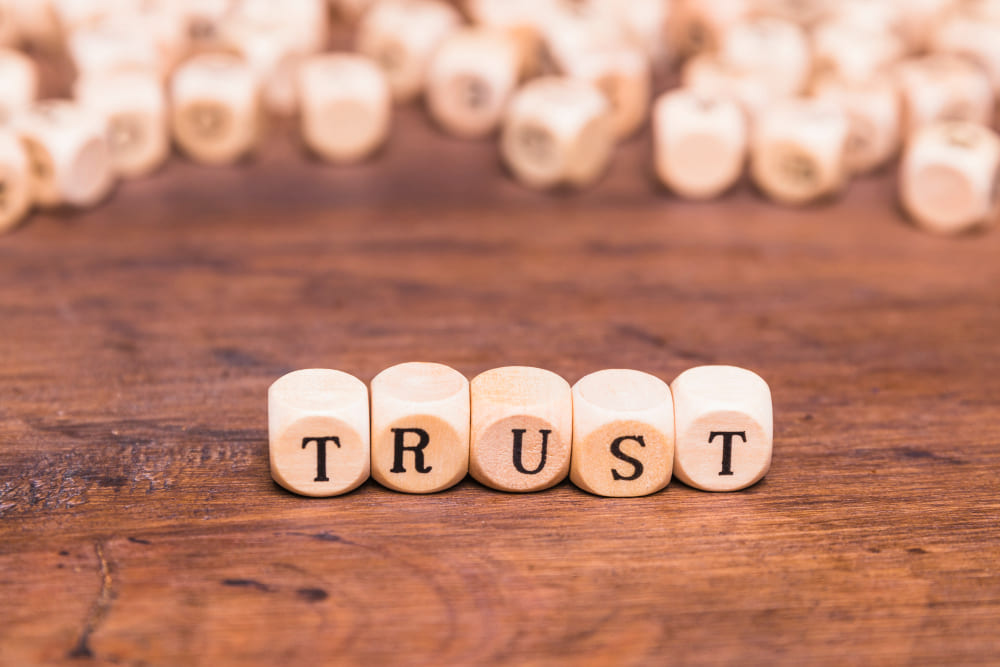
Interacting with global users is now a challenge in itself, as their expectations for content quality are increasingly high.
They expect content that reflects their language and culture. This creates a significant challenge for businesses.
Many users leave a website or app immediately when something feels strange, unfamiliar, unnatural, or out of context.
Even a single mistranslated word can change a user’s perception. For users, even a single awkward sentence can undermine their trust and make them doubt a brand’s professionalism.
An example of this is the KFC slogan ‘Finger-Lickin’ Good‘, which was literally translated into Chinese as ‘Eat your fingers off’.
Most businesses still assume user trust depends only on visual design, product features, or service speed.
In fact, language has a much stronger emotional influence. When users read content in their own language, they feel understood, valued, and invited to communicate as equals.
Therefore, linguistic accuracy is no longer a complement, but the foundation of trust.
Automatically translated content without adjustments often overlooks local nuances, idioms, and cultural sensitivities that are important to users.
As a result, the brand’s message becomes blurred, and its credibility slowly declines without anyone noticing.
This is where certified translation services serve as a bridge between the brand and market expectations. It not only ensures translation quality but also builds user trust by approaching them through their culture.
The Hidden Ways Bad Translation Erodes Trust in Seconds

Source: Freepik.com
Small translation errors often seem trivial, but their impact on a brand can be enormous.
For example, industry-specific terms such as ‘bottleneck’ are often literally translated as ‘leher botol’ in Indonesian.
However, in certain technical contexts, this term refers to a production bottleneck. In addition, UI errors can significantly affect how users interpret language.
For example, in 2018, an automatic translation feature mistranslated the word “Myanmar” into an offensive English phrase.
This issue triggered socio-political consequences. Furthermore, in 2017, Google Home translated ‘device is offline’ into ‘peralatan mati’ in Indonesian, which sounds like ‘broken,’ not ‘disconnected’. Google later corrected this to ‘the device is offline’.
Small mistakes can make global brands look amateurish, as if they don’t understand their products or value local markets.
Furthermore, technical errors—like unclear safety warnings or incorrect medical device instructions—can make the product seem unsafe.
In an era where users instantly compare quality across brands, linguistic details and local experience are not just about aesthetics; they are indicators of professionalism.
Therefore, consistency in terminology, technical validation, and cross-language UI testing are crucial investments to maintain a trusted and competent global reputation.
Why “Regular Translation” Fails for High-Stakes Content
Contrary to popular belief, certified translation is not simply a ‘neater’ version of regular translation.
Regular translation focuses on conveying meaning, but without a rigorous quality-control process.
In contrast, certified translation requires translators to follow certain verification procedures—from checking standardised terminology to proving that the final result meets official institutional standards.
There is a clear chain of responsibility because certified documents may carry legal, financial, or technical implications.
The problem is that many people assume that all translations carry the same weight. In regular translations, nuances can be adjusted, the style of language can be more relaxed, and a small margin of error is still acceptable.
However, in certified translations, a single misplaced term can change the interpretation of a contract, technical specifications, or regulatory decisions.
Therefore, the process involves terminology consistency and cross-verification with the source document.
Many global brands often stumble here. They assume that their in-house linguistic team or general translators are sufficient to handle important content, when in fact, without certified translation, they lose the layer of accuracy needed to maintain legal compliance or industry standards.
Regular translation prioritizes communication; certified translation prioritizes accountability.
When the stakes are high, what you need is not just for the message to be conveyed, but proof that the translation is accountable before institutions, business partners, or the law.
Certified Translation as a Trust-Building Tool in the Global Market
Certified translation provides an essential layer of assurance for legal compliance and document accuracy.
With certified translators, every technical, legal, and administrative term is ensured to be consistent, thereby reducing the risk of misinterpretation that could impact official processes.
Furthermore, certification protects the reputation of individuals and organisations because translated documents have a clear basis of validity and are accountable before government agencies, educational institutions, or legal authorities.
Certified translation also ensures standardized official documentation. Certified documents not only prove that the translation is equivalent to the original but also demonstrate that a professional verification process has been conducted.
This makes the document more readily accepted by agencies that require specific standards, thereby minimising revisions, rejections, or other administrative obstacles.
However, beyond its administrative function, certified translation can also be viewed as a branding strategy.
The use of certified translations demonstrates an organization’s commitment to quality, professionalism, and integrity in global communication.
With this step, companies build an image as serious, trustworthy entities that value international standards, thereby increasing the trust of partners, clients, and the public.
When The Part Certified Translation Meets Localization: The Part AI Can’t Fix
When certified translation meets localization, there is often a gap between linguistic accuracy and experiences that are truly meaningful local experiences.
Certified translation ensures that every word, legal term, or piece of technical information is translated with a high degree of accuracy.
The result is verifiable, accountable, and compliant with official standards. However, accuracy alone is not always enough to make a message feel alive and relevant to audiences in a particular country or culture.
This is where localization plays a crucial role. Localization is not just about translating; it involves adapting the context, communication style, idioms, and cultural preferences so that the message feels natural and relatable to local users.
Without this process, even an accurate translation can sound stiff, foreign, or even lead to misinterpretation.
Cultural Nuances, AI Limitations, and How SpeeQual Bridges the Gap
This becomes especially clear when dealing with cultural nuances. In Japanese culture, expressions of respect are highly valued, so direct translations from English often need to be adapted to maintain a level of politeness.
On the other hand, the Malaysian market often uses a rojak communication style—a blend of Malay, Chinese, Tamil, and English. In addition, the use of words that are not to the point to maintain harmony needs to be considered.
AI can help speed up the process, but it still struggles to read social context, humour, cultural sensitivities, and subtle local preferences.
Therefore, collaboration between certified translation and localization—supported by human cultural judgment—remains key to creating messages that are both accurate and meaningful.
With a mission to bridge brands with local users, we at SpeeQual will assist you through certified translation services.
This stems from our awareness that regular translation alone is not enough.
It is necessary to understand the cultural context and specific terminology without violating local regulations. We carry out this work with accuracy, speed, and cultural precision.
Rebuilding Credibility Isn’t About More Content—It’s About More Accurate Content

Source: Freepik.com
Rebuilding credibility is not about producing more content, but ensuring that every piece of information released is accurate, precise, and verifiable.
In an era where audiences are increasingly critical, certified translation is an important foundation for ensuring that the same accurate message can be understood across languages without distortion. Without accuracy, content volume actually accelerates the loss of trust.
However, accuracy alone is not enough. Brands must ensure their messages remain relevant, contextual, and resonant in each market.
This is where localisation plays a strategic role—adapting communication styles, cultural references, and linguistic nuances so that messages are not only correct, but also meaningful locally.
The combination of the two creates stronger and more sustainable global communication.
Strategically, global trust is restored through consistency, not volume. Certified translation and localisation are a powerful combination that strengthens brands from their foundations through every stage of expansion.
For this reason, it is crucial to work with a partner who understands both, especially for companies targeting multilingual markets such as Southeast Asia.